
Lease accounting concepts (PSAK 116 / IFRS 16)
Nextera Accord is a lease accounting platform. Almost every decision it asks you to make comes from one accounting standard, so it is worth understanding that standard before you open the product.
Which standard applies to you
Section titled “Which standard applies to you”IFRS 16 Leases replaced IAS 17 and applies to entities reporting under IFRS.
PSAK 116 Sewa is the Indonesian adoption of IFRS 16. Its history matters, because the numbering is a common source of confusion:
| Standard | Status |
|---|---|
| PSAK 30 Sewa | The former Indonesian lease standard, based on IAS 17 |
| PSAK 73 Sewa | Issued 2017 as the IFRS 16 adoption; effective 1 January 2020, superseding PSAK 30 |
| PSAK 116 Sewa | The same standard, renumbered so Indonesian numbering aligns with IFRS numbers. Ratified by DSAK IAI in December 2022, effective 1 January 2024 |
PSAK 116 and PSAK 73 are not two different standards. If your policy documents still say PSAK 73, they are out of date in numbering, not in substance.
What counts as a lease
Section titled “What counts as a lease”A contract is, or contains, a lease if it conveys the right to control the use of an identified asset for a period of time in exchange for consideration. There are three tests, and all of them must hold:
- There is an identified asset. Specified explicitly or implicitly. If the supplier has a substantive right to substitute an alternative asset — and would benefit economically from doing so — there is no identified asset, and therefore no lease.
- You obtain substantially all of the economic benefits from using that asset over the period of use.
- You direct how and for what purpose the asset is used over that period.
This is why the assessment is a contract-by-contract exercise rather than an asset-register exercise, and why the first weeks of an implementation are dominated by contract review rather than by system configuration.
It is also why “lease” in the accounting sense is wider than “lease” in the commercial sense. Service contracts, outsourcing arrangements, warehousing agreements and IT hosting contracts routinely contain leases; contracts titled “lease” occasionally do not.
The lessee model: one model, two exemptions
Section titled “The lessee model: one model, two exemptions”IFRS 16 removed the operating/finance split for lessees. Every lease produces:
- a right-of-use (ROU) asset — your right to use the underlying asset; and
- a lease liability — your obligation to make the lease payments.
Two optional recognition exemptions exist, applied as policy choices:
- Short-term leases — a lease term of 12 months or less at commencement, with no purchase option. Elected by class of underlying asset.
- Low-value assets — assessed on the value of the asset when new, in absolute terms, not by materiality to your financial statements. Elected lease by lease.
Exempt leases are expensed on a straight-line basis (or another systematic basis) and still carry disclosure obligations. Electing an exemption reduces measurement work; it does not remove the lease from your population.
Measuring the lease liability
Section titled “Measuring the lease liability”At the commencement date, the liability is the present value of the lease payments not yet paid.
Lease payments included:
- fixed payments, less any lease incentives receivable;
- variable payments that depend on an index or rate, measured using the index or rate as at commencement;
- amounts expected to be payable under a residual value guarantee;
- the exercise price of a purchase option, if reasonably certain to be exercised;
- termination penalties, if the lease term reflects exercising a termination option.
Variable payments linked to usage or sales are excluded from the liability and expensed as incurred. This is one of the most common measurement errors, and it is worth checking explicitly on every contract with a turnover-linked rent.
The discount rate
Section titled “The discount rate”Use the interest rate implicit in the lease if that rate is readily determinable. It usually is not — it requires knowing the lessor’s initial direct costs and the unguaranteed residual value — so lessees generally use the incremental borrowing rate (IBR): the rate you would pay to borrow, over a similar term and with similar security, the funds needed to obtain an asset of similar value in a similar economic environment.
Your IBR methodology is a policy decision your auditor will test. Settle it before implementation, not during. The questions that need answering are: at what level are rates derived (entity, currency, term band, asset class), how often are they refreshed, and what observable inputs support them.
Measuring the right-of-use asset
Section titled “Measuring the right-of-use asset”ROU asset = lease liability at commencement + payments made at or before commencement − lease incentives received + initial direct costs + estimated dismantling / restoration / site-restoration costsSubsequent measurement
Section titled “Subsequent measurement”The liability is carried at amortised cost using the effective interest method: it accretes interest and is reduced by payments made.
The ROU asset is depreciated, normally straight-line, over the shorter of the asset’s useful life and the lease term — except where ownership transfers at the end of the term, or a purchase option is reasonably certain to be exercised, in which case depreciation runs over the asset’s useful life. Impairment testing under IAS 36 applies.
The practical consequence, and the one to explain to non-accountants early: a lease that used to be a flat straight-line rent expense now produces front-loaded total expense (interest is highest when the liability is largest, while depreciation is level), and the cash outflow moves from operating to financing in the cash flow statement. EBITDA improves; that is an artefact of the standard, not of performance.
Remeasurement: the part that actually consumes your month
Section titled “Remeasurement: the part that actually consumes your month”Remeasurement is the operational heart of lease accounting, and the reason a spreadsheet stops scaling somewhere between fifty and a few hundred leases. The trigger determines whether the discount rate is revised:
| Trigger | Revise the discount rate? |
|---|---|
| Change in the assessment of a purchase option | Yes |
| Change in the lease term (extension or termination reassessment) | Yes |
| Change in amounts expected under a residual value guarantee | No — use the original rate |
| Change in future payments from a change in an index or rate | No — use the original rate |
| Change in future payments from a change in floating interest rates | Yes |
Remeasurements adjust the ROU asset. If the ROU asset has already been reduced to nil, the remainder goes to profit or loss.
Modifications are distinct from remeasurements. A modification that adds the right to use one or more additional assets, at a price commensurate with the stand-alone price, is accounted for as a separate lease. All other modifications remeasure the existing lease.
Lessor accounting is unchanged
Section titled “Lessor accounting is unchanged”IFRS 16 kept the dual model for lessors. Leases are still classified as finance or operating, based on whether substantially all the risks and rewards incidental to ownership transfer to the lessee. If you are a lessor as well as a lessee — common for insurers with property portfolios, and for anyone who subleases — you are running two different models simultaneously.
What you have to disclose
Section titled “What you have to disclose”IFRS 16 requires lessees to disclose, in a single note or separate section of the financial statements:
- depreciation charge for ROU assets, by class of underlying asset;
- interest expense on lease liabilities;
- expense relating to short-term leases, and to low-value asset leases;
- expense relating to variable lease payments not included in the liability;
- income from subleasing ROU assets;
- total cash outflow for leases;
- additions to ROU assets;
- gains or losses arising from sale-and-leaseback transactions;
- the carrying amount of ROU assets at the reporting date, by class.
Plus a maturity analysis of lease liabilities, presented separately from other financial liabilities.
The disclosure list is effectively the specification for your reporting module — which is why disclosure requirements, not journals, should drive how you structure your lease data. A lease register that cannot split by class of underlying asset cannot produce the required note, no matter how correct its arithmetic is.
How these concepts map to Nextera Accord
Section titled “How these concepts map to Nextera Accord”This section turns everything above into the screens, tabs and fields you actually see. Every name below is the application’s own label, and the application’s labels are in English.
One measured contract is one Lease record
Section titled “One measured contract is one Lease record”The top-level record a user creates is called a Lease, and it is opened from the Lease menu. Its identity is the Lease No, generated automatically by the Auto Number configuration. One Lease points at one Lessor, one Lease Class, one Lease Category, one Lease Branch, and one Contract No drawn from the Contract master data.
Because Contract is master data in its own right, an umbrella contract covering several assets or several separately measured components is represented by several Lease records sharing the same Contract No. That is how components are separated inside the product — the split happens at Lease record level, not as component rows inside a single record.
Classification happens on the Questionnaire tab
Section titled “Classification happens on the Questionnaire tab”The questionnaire is what determines how a contract is treated, and it is required. As soon as you save a new Lease, the Questionnaire screen opens; you answer it and then press Continue to move on to the remaining fields.
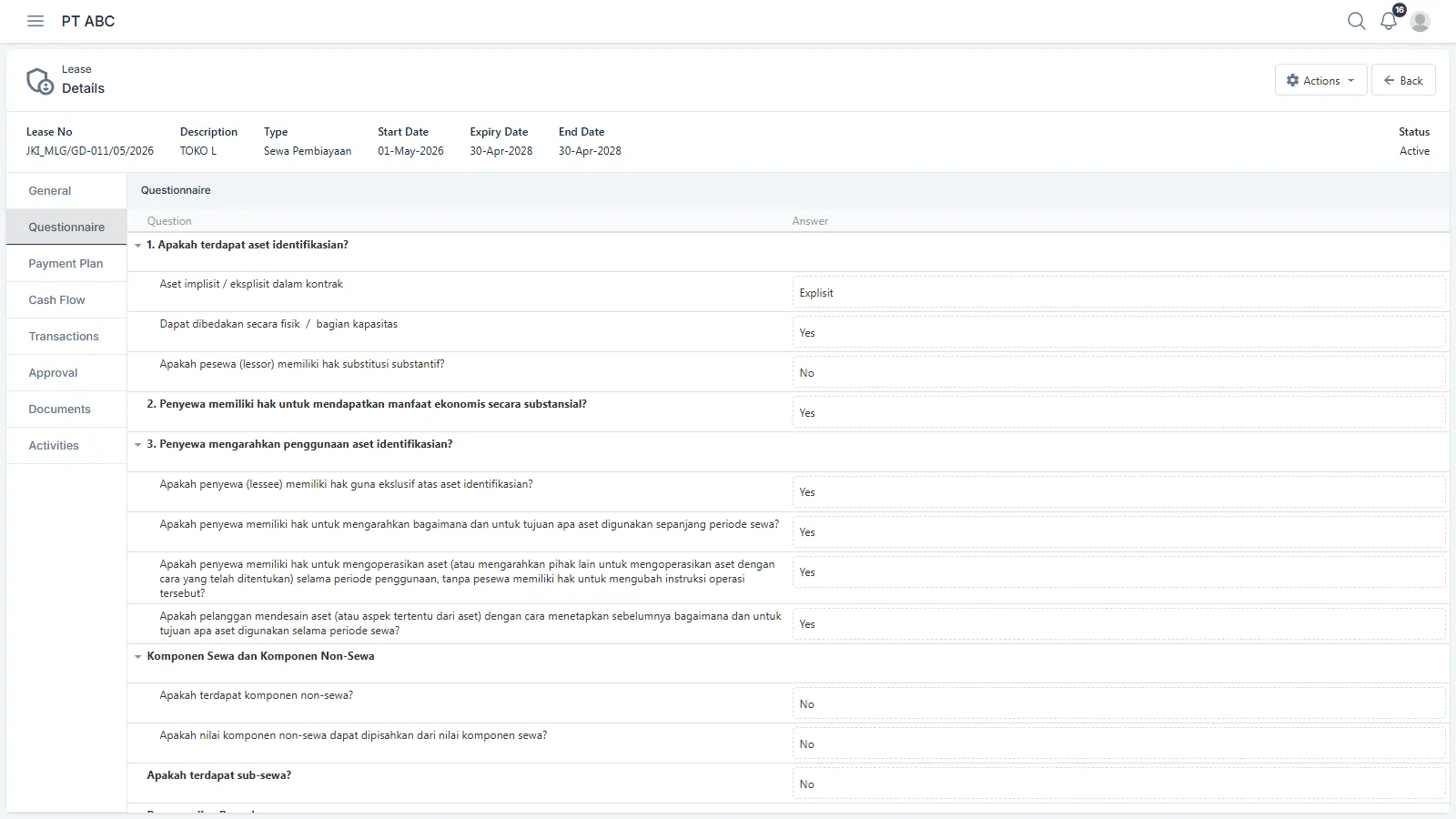
It is laid out in two columns, Question and Answer, and the questions — which the product asks in Indonesian — follow exactly the three tests described above:
| Question group | What it assesses |
|---|---|
| Is there an identified asset? | Whether the asset is implicit or explicit in the contract, whether it is physically distinct or a portion of capacity, and whether the lessor has a substantive substitution right |
| Does the lessee obtain substantially all of the economic benefits? | The second test |
| Does the lessee direct the use of the identified asset? | Exclusive right of use, the right to direct how and for what purpose the asset is used, the right to operate it, and whether the customer designed the asset |
| Lease components and non-lease components | Whether there are non-lease components, and whether their value can be separated from the value of the lease components |
| Sublease | Whether a sublease exists |
| Recognition exemptions | The short-term and low-value recognition exemptions |
Some rows are read-only — those are answers the system derives from other answers, not ones you fill in.
The questionnaire result lands in the Lease Type field on the General tab, and it is Lease Type that decides whether this contract gets a measured ROU asset and lease liability — schedules and all — or not. The display values for Lease Type come from reference data in your environment, so check them with your implementation consultant at setup.
Note two points that bear directly on the discussion of exemptions above. First, the answers in the recognition exemption group can downgrade the classification result, so that the contract is not measured at all. Second, the short-term assessment uses a duration calculated from Start Date and Lease End Date on the Lease record itself — so get both dates right before you conclude anything from the questionnaire.
The discount rate is a field, not a table
Section titled “The discount rate is a field, not a table”The discount rate lives as Annual Discount Rate on the General tab of the Lease record. One lease, one number, and it can only be entered while the status is still Draft.
Nextera Accord does not hold an IBR policy table. What System Settings offers is Currency Rate, which is a foreign exchange rate, not an interest rate table. The consequence is blunt, and needs to be agreed before implementation: your IBR methodology lives in a policy document, and all that reaches the system is its output, one rate per lease. The trail of who entered it and when sits on the Activities tab of the same record — that is what you will show the auditor.
Lease payments arrive through the Payment Plan tab
Section titled “Lease payments arrive through the Payment Plan tab”Payment Plan is an input to the calculation, not its output. The grid has four columns
— Period, Payment Date, Amount, Notes — sorted ascending by Period.
For a Payment Type of Constant, Single or Full Payment, the system can generate the schedule itself from Estimate First Payment Date, Frequency, Number of Payment and Payment Amount on the General tab. For a Payment Type of Variable, you enter the rows yourself or upload them.
Measurement runs through the Calculate action
Section titled “Measurement runs through the Calculate action”Initial and subsequent measurement are calculated together by the Calculate action on the Actions menu, and the result is a daily schedule — one row per day, from commencement to the end of the lease term. A two-year lease produces around 730 rows; that is normal, and the grid’s page size goes up to 5000 rows for exactly that reason.
The columns, named as they actually appear on screen:
| Column | What it holds |
|---|---|
Projection Day · Start of Period · End of Period |
The projection day number and its boundaries |
Initial Prepaid |
Populated on the first row only |
Discount Rate |
The discount factor for that day |
Lease Liability (BOP) · (EOP) |
The liability at the beginning and end of the period |
Principal Payment · Interest Expense |
The split of the payment into principal and interest |
Right of Used Asset (BOP) · (EOP) |
The carrying amount of the ROU asset at the beginning and end of the period |
Depreciation |
Straight-line depreciation |
Discounted Cash Flow |
The discounted cash flow |
The Show Actual checkbox adds actual columns alongside the projected ones.
A schedule that has been calculated but not yet approved appears on the Result tab. Once the lease is approved and becomes active, the schedule in force appears on the Cash Flow tab. The two never appear together — if the tab you are looking for is missing, check the record’s status first.
Remeasurement is a Lease Transaction
Section titled “Remeasurement is a Lease Transaction”Once a lease is active, none of its measurement numbers is changed by editing the Lease record. Every change is recorded as a new record in the Lease Transactions module, and that is where the triggers set out in the remeasurement table above are given effect:
| Trans Type | What it is for |
|---|---|
Modification |
Remeasurement and contract modification |
Termination |
Ending a lease before its term expires |
Adjustment |
A value adjustment to a lease already running |
Correction |
A correction to a lease already running |
Transfer Asset |
Moving a lease between branches |
The transaction screen shows a Current Value column beside a Your Changes column, both pre-filled with the values in force on the Effective Date you choose. You change only what actually changed, and the system flags which fields moved. So the decision you take from the trigger table above — whether the lease term changed, whether the index changed, whether the purchase option was reassessed — becomes one Trans Type plus one Modification Type, and is then recalculated through Calculate.
The map in brief
Section titled “The map in brief”| Concept on this page | Where it lives in Nextera Accord |
|---|---|
| The three tests — identified asset, economic benefits, right to direct use | Lease › Questionnaire tab |
| Lease and non-lease components, subleases | Lease › Questionnaire tab |
| The short-term and low-value recognition exemptions | Lease › Questionnaire tab, with the result in the Lease Type field |
| The discount rate | Lease › General tab › Annual Discount Rate |
| The lease payments that enter measurement | Lease › Payment Plan tab |
| Initial ROU asset — liability, prepayments, initial direct costs | Lease › General tab › Initial Prepaid and Initial Direct Cost, then the Calculate action |
| Subsequent measurement — interest and depreciation | The Interest Expense and Depreciation columns on the Cash Flow tab |
| Remeasurement triggers and modifications | The Lease Transactions module |
| Monthly values for the current period | The Batch Transactions module, the Monthly Valuation job |
| Journals and the ledger | Journal Entries, then Ledger |
| Disclosure and movement schedules | The Reports module |
The catalogue of available reports is configured per installation. On the installation we examined, the Lease group carried, among others, Mutasi Liabilitas Sewa, Mutasi Aset Hak Guna, Rincian Beban Sewa, Rincian Pembayaran Sewa, Rincian Sewa Dibayar Dimuka, Projection Summary, Actual Cashflow and Rincian Journal — Accord’s report names are Indonesian, and between them these are enough to build the movement schedules and expense breakdowns the standard requires. Match the list in your own environment against the disclosure list above at setup, not at your first close.